

(Not) moving with the times, part 4: Who does their own bike maintenance these days?
Apart from me, that is.
I started cycling as a teenager. It was a way of getting too and from school, of getting about town and visiting friends. Aside from a short tour with my father in the Scottish Borders, I was basically a utility cyclist. Back in those days, I had fairly cheap road bike with a 5 speed freewheel and a double chainset (still fairly unusual at that time, at least for kids’ bikes). I don’t think the basic technology of bikes had changed much since my father took up cycling in the 1950s. You really didn’t need much in the way of tools, and it seemed natural to me to pick up the basics of bike maintenance from my father. There were occasions where a specialist tool was needed - a memorable example was when I changed from a steel chainset with cotter pins to an SR alloy cotterless chainset (this would have had a square taper bottom bracket), I didn’t have a spanner that would fit into the crank arm to tighten the bolt. In the end, we popped into George Pennel’s bike shop in Peebles to ask about it. He lent us the appropriate Campagnolo spanner , saying to return it the following week (after that we were lifelong customers until George died and the shop changed hands).

For cyclists, George Pennel was an important figure in the area. Cyclists would ride there from Edinburgh any beyond, oftenhaving a cup of tea in the courtyard. I can remember the back of the shop having a huge heap of old bike parts from which George would recover parts to repair a busted derailleur! I think my last visit to George’s was at the end of a tandem cycle tour in southern Scotland when I’d arranged to meet my father there for the last section of the tour and heading back to Edinburgh. George told me that 40 spokes wasn’t enough for a rear tandem wheel. He was right, though I often wonder what he’s have made of our current 32-spoke Rohloff tandem wheel!
There’s a Pennel Close in Peebles, presumably named after George, and his bike shop.
Eventually I left home (and my bike) for University. With my studies and social life I didn’t have need of a bike, especially as everything was really in walking distance. By the time I had completed two degrees and spent a few years in the big city as a postdoctoral scientist, I was beginning to feel a bit unfit and flabby. So when I relocated back to Scotland, I decided it was time to get started with cycling. My father arranged to buy a decent budget road bike (a Raleigh model at about £300) from George Pennel.
By this time, the cycling world had moved from freewheels to freehubs and 7-speed cassettes, but still, the range of tools needed for bike maintenance was still pretty modest. This was before the rise of YouTube channels, and I relied on manufacturers’ instruction leaflets, and the occasional articles in Cycling Weekly (in those days it was still a useful weekly magazine) to learn how to deal with stuff. And of course things were still so simple that trial and error yielded solutions. Over the years, I've acquired a pretty complete set of tools that cover just about any maintenance I am likely to do - this has been by just buying tools as they became needed.
Fast forward to 2026, and most of my club mates now use professional bike mechanics to service and maintain their bikes. I think there are more bike mechanic services in the area than actual bike shops, and I know that some of them are very highly regarded. I think a driver for all this is that we’ve gone from 7-speed to 12 and even 13-speed with several incompatible gearing systems. Disc brakes, particularly hydraulics, add a further level of complexity. And let’s not touch on the ludicrous number of bottom bracket standards. There’s a good Park Tool page on the actual types of BB shell (English and Italian threaded, press-fit and others), and tools required to fit the myriad of bearing cups, but the real complexity comes with the axle and bearings and how they fit into the BB shell. Here's a list of Park Tool BBcup tools - I think that when buying tools for this purpose, quality is essential when you're tightening things to about 40Nm or higher and the cup is fashioned from an aluminium alloy.
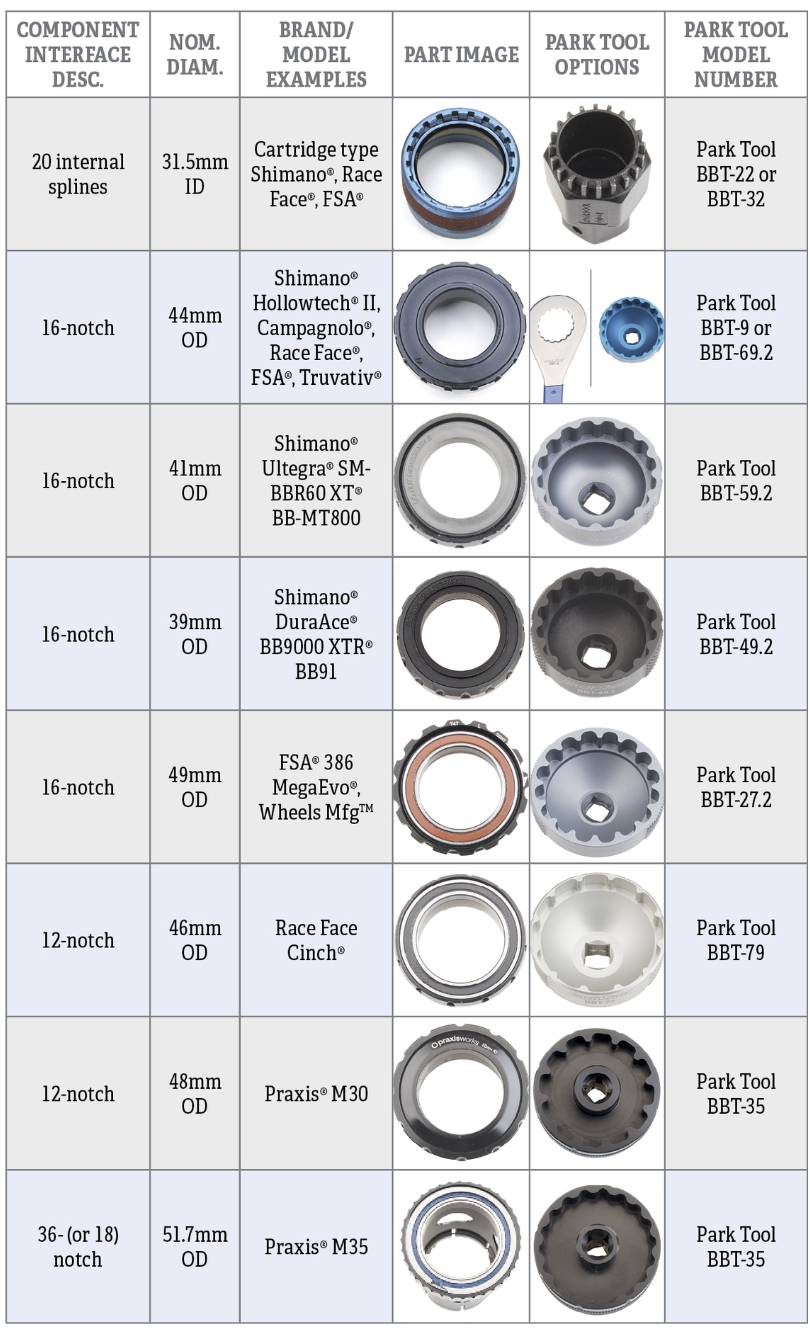
One downside to the general move to is that bike mechanics seem to be somewhat over-subscribed, meaning that it can be a while before the work is completed on a bike.
I’ve always rather enjoyed working on bikes, and with a stable of several bikes (some would say too many bikes), it would be time-consuming to deliver and collect them from a workshop. I’ve tried to keep abreast of current developments in bike tech - see for example earlier blog posts in this series. I haven’t so far been unable to rectify any issues or replace any parts. And I’m dealing with 11-speed transmissions with components from Shimano, SRAM, and Campagnolo, a 12-speed SRAM transmission, and two Rohloff hubs. Both my TT bikes use Campagnolo chainsets, KMC chains, EDCO cassettes and 11-speed SRAM eTap derailleurs.
Of course, there are always innovations in cycling that don’t in my view reward the time and hassle in using (looking at you, tubeless road tyres), and while I don’t anticipate using tubeless long-term on the whole I don’t find managing tubeless tyres unduly difficult.
When you subscribe to the blog, we will send you an e-mail when there are new updates on the site so you wouldn't miss them.

Comments